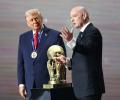
FIFA President Gianni Infantino reportedly sought support from the Trump administration following the collapse of his plan to sell a stake in World Cup commercial rights, facing mounting criticism and feeling 'isolated' by negative media coverage.

Former US President Donald Trump lauded Prime Minister Narendra Modi as a 'great leader' and 'tough guy' who has been in power for over 12 years, placing him alongside China's President Xi Jinping as leaders he admires for their power and ability to execute.

United States President Donald Trump has threatened to resume 'very hard' attacks on Iran, expressing frustration over Tehran's delays in signing a negotiated deal and citing the downing of a US Apache helicopter as grounds for renewed military action. Russia has called for restraint and a return to diplomacy amidst escalating tensions.

US President Donald Trump and Israeli Prime Minister Benjamin Netanyahu are reportedly planning a White House meeting as early as next week, despite growing scepticism within Trump's inner circle regarding Netanyahu's actions and widening disagreements over regional security and Iran.

AAP national convener Arvind Kejriwal has criticised Prime Minister Narendra Modi for thanking US President Donald Trump, arguing that India's sovereignty and national interest should be paramount. Kejriwal questioned the basis of Modi's gratitude, citing incidents involving attacks on ships carrying Indians and the deaths of Indian nationals, and called for strong leadership to protect India's interests.

The US on Monday announced that it had revoked more than 1.75 lakh visas during President Donald Trump's tenure for a range of crimes from reckless driving to sexual assault.

Former US President Donald Trump personally intervened with FIFA President Gianni Infantino to overturn a red-card ban for US striker Folarin Balogun, a decision UEFA called 'unprecedented, incomprehensible and unjustifiable' and which has sparked widespread criticism over the integrity of the game.

External Affairs Minister S Jaishankar met US Secretary of State Marco Rubio on the sidelines of the UN General Assembly session in New York. India raised its concerns regarding the recently signed "Lindsey O. Graham Sanctioning Russia and Iran Act of 2026," which authorises tariffs on countries buying Russian oil and gas. Both leaders also discussed bilateral relations, regional priorities, and the situations in the Gulf and Ukraine.

Indian stock market investors are closely monitoring crude oil prices, geopolitical developments in West Asia, and the implications of the US Sanctioning Russia and Iran Act, which could impose tariffs on countries, including India, that purchase Russian crude.

On Thursday, September 24, Chinese President Xi Jinping and his wife Peng Liyuan were accorded a warm welcome by President Donald Trump and First Lady Melania Trump at the White House in Washington, DC.

Donald Trump announced he is replacing the 20% reimbursement fee for securing the Strait of Hormuz with massive trade and investment deals from Gulf States into the United States, while maintaining a full blockade on Iranian ship traffic.

Donald Trump claims a peace deal with Iran is 'largely negotiated' after calls with Israel and other allies, but Iran rejects Trump's claim on Strait of Hormuz.

United States President Donald Trump boards Air Force One for his return home following diplomatic engagements in Beijing.

He has been indicted on seven federal criminal charges for retaining hundreds of classified government documents and even making false statements after leaving the White House, it reported.

US President Donald Trump on Tuesday said that Washington has launched a fresh wave of strikes against Iranian targets near the Strait of Hormuz. They come after what Trump claimed was in retaliation for Iran attempting to add sea mines to the Strait.

US President Donald Trump has accused Iran of bringing down an American military helicopter near the strategically vital Strait of Hormuz, prompting a strong declaration that the United States 'must' respond to this significant incident.

Indian benchmark indices Sensex and Nifty opened higher, extending gains from the previous session, driven by a rally in global markets and a slight cooling in crude oil prices. Optimism around a potential meeting between US and Iranian presidents also contributed to positive sentiment.Later both indices pared gains and were trading in red. Track Sensex, Nifty on September 22.

External Affairs Minister S Jaishankar highlighted that India's primary concern regarding terrorism from its neighbour, Pakistan, if not fully appreciated by partners like the US, negatively impacts bilateral relations. Speaking at the Asia Society, Jaishankar discussed the turbulence in India-US ties, particularly in light of Washington's renewed engagement with Pakistan and the perceived lack of empathy for India's terrorism concerns, especially under the second Trump administration. He emphasized that addressing these sensitivities is crucial for improving the relationship.

This evening, President Biden spoke to former President Trump. The President also spoke to Pennsylvania Governor Josh Shapiro and Butler Mayor Bob Dandoy, the White House said.

US Ambassador to India Sergio Gor revealed that President Donald Trump views Prime Minister Narendra Modi as 'a friend' and is deeply committed to enhancing cooperation with New Delhi, highlighting their personal equation as a crucial factor in advancing bilateral ties.

President Donald Trump and First Lady Melania Trump were rushed to safety after gunshots were heard during the White House correspondents' dinner in Washington.

The US-Canada trade war has escalated sharply, with US President Donald Trump on Monday announcing that tariffs on Canadian cars, trucks, automotive parts and steel imports will be raised to 50 percent from January 2027, following the collapse of trade negotiations between Washington and Ottawa last week.

Italian Prime Minister Giorgia Meloni has strongly rebuked former US President Donald Trump's claims that she 'begged' for a photo-op at the G7 summit, dismissing his remarks as 'utterly fabricated' and asserting, 'Italy and I never beg.'

Following a New York jury's verdict, former President Donald Trump stands convicted on all 34 felony charges of falsifying business records, raising pertinent questions about his future political endeavours and voting rights, CNN reported.

US President Donald Trump is expected to sign the Lindsey O. Graham Sanctioning Russia and Iran Act of 2026 later on Friday (local time). A White House official confirmed the development to ANI without revealing further details.
US President Donald Trump has signed two executive orders aimed at cracking down on 'birth tourism' and limiting eligibility for birthright citizenship, weeks after the Supreme Court rejected a similar directive.

Belgium players celebrated their 4-1 FIFA World Cup 2026 Round of 16 victory over hosts United States with a dance inspired by US President Donald Trump. Romelu Lukaku and teammates performed the viral dance after Lukaku's stoppage-time goal sealed their quarter-final spot. The US Men's National Team thanked supporters after their elimination, while Belgium, led by Charles De Ketelaere's brace, will face Spain next.

The US Treasury Department is exploring the possibility of featuring Donald Trump's portrait on a new $250 note, pending congressional approval to amend the law that prohibits living individuals from being depicted on US currency.

A coalition of 25 Democratic-ruled US states has filed a lawsuit against the Trump administration's decision to impose new tariffs on 60 economies, including India. The states contend that these tariffs, ostensibly aimed at combating forced labour, are illegal taxes that will raise costs for consumers and businesses, and were implemented without proper legal justification.

US President Donald Trump has lauded India as an 'essential partner' and 'trusted ally' in addressing regional challenges, particularly its 'big role' in West Asia peace efforts, following discussions with Prime Minister Narendra Modi at the G7 Summit.

Jammu and Kashmir Chief Minister Omar Abdullah shared a fabricated social media post attributed to former US President Donald Trump, captioned 'If only!', to highlight his demand for the restoration of J&K's statehood, drawing significant criticism online.

US President Donald Trump on Friday (local time) said the United States could "hit" Iran's heavily fortified underground nuclear site known as Pickaxe Mountain "very soon", days after Washington targeted Iranian military targets.
US President Donald Trump lauded Prime Minister Narendra Modi's 'calm, cool, killer' persona at the G7 leaders' lunch in France, underscoring the deeply strategic relationship and formidable diplomatic skills of the Indian leader ahead of their crucial bilateral meeting.

US Republican Senator Lindsey Graham, a prominent ally of former President Donald Trump and an influential voice on American foreign policy, has passed away at 71 following a 'brief and sudden illness', leaving a significant void in Washington's political landscape.

US President Donald Trump has lauded a newly announced peace deal between the United States and Iran, predicting it will bring "peace and security" to West Asia and facilitate the reopening of the strategically vital Strait of Hormuz.

Donald Trump agreed with Xi Jinping's assessment of the US as a 'declining nation,' but attributed the decline to the policies of the Biden administration.

US President Donald Trump revealed he was on the verge of ordering attacks on Iran but postponed the decision after receiving calls from Qatar and the UAE, citing progress in peace talks.

Iran's Khatam al-Anbiya Central Headquarters has threatened "continuous, effective and painful" attacks on US bases and interests across the region if Washington resumes military action against Tehran, amid escalating tensions and a US naval blockade on Iranian ports.

US President Donald Trump has abruptly withdrawn from a peace deal with Iran, citing fresh intelligence of Iranian assaults on commercial vessels in the Strait of Hormuz. The decision, made just a fortnight after celebrating the deal, has led to a significant military escalation in the region, with the US launching extensive counter-operations against Iranian military infrastructure.
Donald Trump took the first flight on the newly refurbished Air Force One, a Boeing 747-8i previously owned by Qatar and gifted to the US presidential fleet. The jet features a new red, white, and navy blue livery, replacing the older robin's egg blue. Trump expressed excitement about the advanced security and features, noting it will serve as a "bridge" until new planes are delivered by 2028.
